
The Ultimate Lemon Dill Chicken Risotto Recipe: Creamy Oven-Baked Perfection
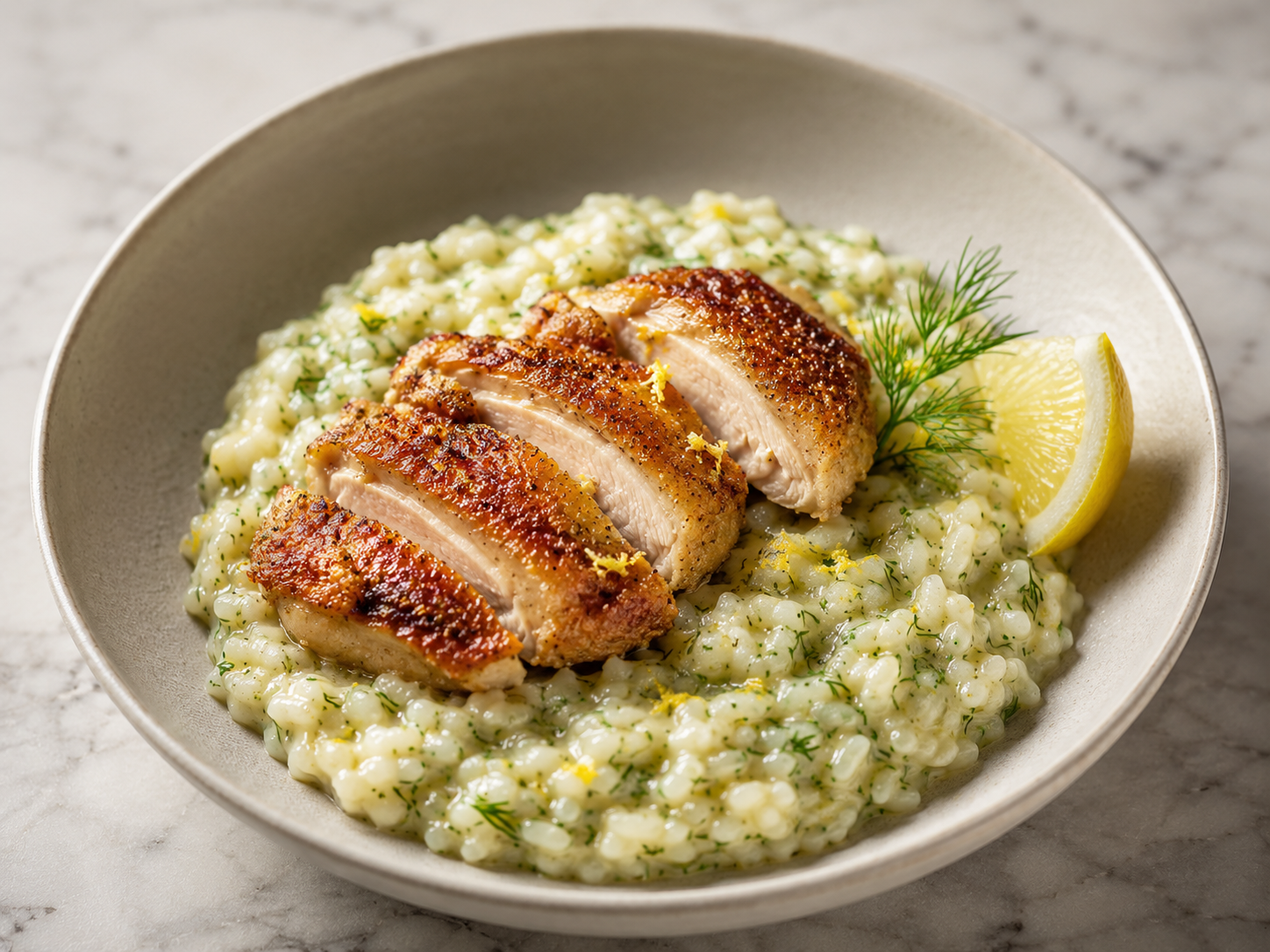
Can you make risotto without stirring? This lemon dill chicken risotto recipe uses an oven-baked method — the most efficient way to make a creamy risotto without constant stirring. By using a heavy-bottomed pot (like a Dutch oven) and the correct ratio of 3 parts liquid to 1 part arborio rice, the heat circulates evenly, releasing the rice starch to create a velvety texture while you focus on roasting the chicken.
Forget everything you know about standing over a hot stove for 45 minutes. This lemon dill chicken risotto recipe uses a brilliant oven-baked technique that delivers restaurant-quality results with half the effort. The combination of zesty lemon, aromatic fresh dill, and succulent roasted chicken creates a bright, sophisticated flavor profile that is perfect for both a cozy weeknight dinner and an elegant dinner party.
The conventional method for making risotto is genuinely incompatible with a busy schedule. Standing at a stove for 45 minutes, adding warm stock ladle by ladle, requires undivided attention that competes directly with everything else happening in a productive household. The oven-baked method changes that calculation entirely. Ten minutes of active prep: sauté aromatics, toast rice, pour in stock, season chicken, place in oven, set timer. Walk away. Come back 30 minutes later to a completed dish. The physics of convection heat does the stirring work while you decompress. The result is indistinguishable from the stovetop version — and the cooking experience actually fits a real schedule.
Why Oven Heat Transforms Risotto: The Science of Starch and Steam
How Convection Heat Replaces Manual Stirring
Traditional stovetop risotto relies on constant stirring to accomplish two things: agitate the rice to release amylopectin starch from the grain surface, and ensure even heat distribution throughout the liquid. A covered Dutch oven in a 400°F (200°C) oven achieves both effects through convection — hot air circulates around the sealed vessel, creating consistent ambient heat that drives gentle, continuous thermal movement within the liquid. This movement agitates the rice without mechanical stirring. The amylopectin release is slightly slower than stovetop, which is why the single vigorous stir at the end (when you remove the chicken) is critical: that final agitation releases a burst of surface starch that creates the characteristic creamy coating.
Arborio Rice: Why Starch Variety Is Non-Negotiable
Arborio rice contains a starch composition that is approximately 85% amylopectin (versus 70–75% in standard long-grain rice). Amylopectin is a highly branched starch molecule that dissolves readily in hot liquid, creating the viscous, creamy sauce that defines risotto. Long-grain rice’s higher amylose content produces a firmer, more separate grain structure — excellent for pilaf, incompatible with risotto. The 3:1 liquid-to-rice ratio in this recipe is calibrated specifically for Arborio’s absorption rate. Substituting another variety will produce undercooked rice in a dry pan or an overcooked, glue-like mass.
Lemon Zest vs. Juice: Volatile Chemistry and Heat Stability
Lemon zest and lemon juice are chemically distinct ingredients that behave oppositely under heat. Zest contains limonene and other volatile aromatic compounds stored in the flavedo (the colored outer layer of the rind) — these are heat-stable and survive the 30-minute bake, infusing the rice with deep citrus aroma. Lemon juice is primarily citric acid and water — its volatile aromatics cook off within minutes, leaving behind only tartness. High acid concentrations during long baking can also interfere with starch gelatinization and curdle dairy components. This recipe uses zest during baking for aroma and adds juice only after the oven step, preserving brightness without sacrificing creaminess.
Nutrition Per Serving — Lemon Dill Chicken Risotto
| Nutrient | Amount |
|---|---|
| Calories | 510 kcal |
| Protein | 32g |
| Fat | 14g |
| Carbs | 58g |
| Fiber | 2g |
Ingredients for This Lemon Dill Chicken Risotto Recipe
- 1.5 cups Arborio Rice — this high-starch rice is non-negotiable for risotto
- 4 cups Low-Sodium Chicken Broth — warm it up before adding to the rice
- 500g Chicken Thighs (Skin-on) use high-quality poultry
- 1 bunch Fresh Dill — finely chopped
- 2 Organic Lemons — both zest and juice
- 1/2 cup Parmesan Cheese — freshly grated
- 2 cloves Garlic — minced
- 1 small Shallot — finely diced
The Ultimate Lemon Dill Chicken Risotto Recipe: Creamy Oven-Baked Perfection
- 1.5 cups Arborio Rice — this high-starch rice is non-negotiable for risotto
- 4 cups Low-Sodium Chicken Broth — warm it up before adding to the rice
- 500g Chicken Thighs (Skin-on) use high-quality poultry
- 1 bunch Fresh Dill — finely chopped
- 2 Organic Lemons — both zest and juice
- 1/2 cup Parmesan Cheese — freshly grated
- 2 cloves Garlic — minced
- 1 small Shallot — finely diced
- Preheat your oven to 400 F (200 C).
- In a Dutch oven, saute shallots and garlic in a bit of olive oil until soft. Add the rice and toast for 2 minutes until translucent at the edges.
- Pour in the warm chicken broth and half the lemon juice. Stir once.
- Season chicken thighs with salt, pepper, and lemon zest. Place them directly on top of the rice/liquid mixture.
- Cover with a lid and bake for 25-30 minutes.
- Remove from the oven. Take the chicken out to rest. Stir the risotto vigorously — this is where the creaminess happens! Fold in the fresh dill, Parmesan, and remaining lemon zest.
- Plate the creamy rice and place the sliced roasted chicken on top.
How to Make Lemon Dill Chicken Risotto (Full Method)
- Preparation: Preheat your oven to 400 F (200 C).
- Saute Aromatics: In a Dutch oven, saute shallots and garlic in a bit of olive oil until soft. Add the rice and toast for 2 minutes until translucent at the edges.
- Add Liquid: Pour in the warm chicken broth and half the lemon juice. Stir once.
- Prepare Chicken: Season chicken thighs with salt, pepper, and lemon zest. Place them directly on top of the rice/liquid mixture.
- Bake: Cover with a lid and bake for 25-30 minutes.
- The Finish: Remove from the oven. Take the chicken out to rest. Stir the risotto vigorously — this is where the creaminess happens! Fold in the fresh dill, Parmesan, and remaining lemon zest.
- Serve: Plate the creamy rice and place the sliced roasted chicken on top.
Storage, Reheating & the Starch Recovery Protocol
Why Risotto Sets Solid in the Refrigerator
Starch retrogradation is the technical name for what happens to risotto overnight. As the amylopectin molecules cool, they re-form partial crystalline structures and expel water — the risotto firms from a creamy, flowing consistency to a solid, sliceable block. This is completely normal and reversible. Store risotto and chicken separately in airtight containers in the refrigerator for up to 3 days. The chicken keeps its texture better stored apart from the starchy base.
The Warm Broth Reheating Protocol
The only correct method for reheating cold risotto is adding warm liquid and stirring over low heat. Add 3–4 tablespoons of warm chicken broth per serving to the cold risotto in a saucepan. Heat over medium-low, stirring continuously, until the liquid is absorbed and the risotto returns to a creamy consistency — approximately 3–4 minutes. The warm broth re-hydrates the retrograded starch, breaking the crystalline structures and restoring fluidity. Cold broth slows this process; hot broth risks over-thickening. Microwave reheating without added liquid produces a rubbery, gluey result.
Freezing Caveat and the Risotto Cake Alternative
Freezing cooked risotto is not recommended for standard serving purposes — thawed risotto has a grainy, broken texture from ice crystal damage to the starch network. However, day-old solid risotto is ideal for a different preparation: risotto cakes. Mix cold risotto with one egg and a handful of breadcrumbs, form into patties, and pan-fry in olive oil for 3 minutes per side until golden. These freeze well after pan-frying and reheat in the oven at 375°F (190°C) for 8 minutes — turning leftover risotto into an entirely new meal with a crispy exterior.
Frequently Asked Questions
Why use chicken thighs instead of breast?
Thighs stay much juicier during the 30-minute bake time.
Can I make this lemon dill chicken risotto dairy-free?
Yes, swap the Parmesan for nutritional yeast or a vegan parmesan alternative.
What if my risotto is too thick after baking?
Simply stir in a splash of warm broth or water until you reach your desired consistency.
Pro Tips for the Perfect Lemon Dill Chicken Risotto Recipe
A few extra details make this lemon dill chicken risotto recipe truly foolproof. First, always warm your chicken broth before adding it to the rice — cold broth shocks the starch and slows cooking. Second, do not skip the vigorous stir at the end; this is the step that releases the starch and creates the signature creamy texture. Third, taste before adding extra salt — parmesan is naturally salty and the broth adds sodium too.
More Recipes You Will Love
Explore more poultry classics in our Chicken & Poultry Category. For official poultry cooking temperature guidelines, visit FoodSafety.gov – Safe Minimum Cooking Temperatures.
This post may contain affiliate links. If you make a purchase through these links, we may earn a small commission at no extra cost to you. See our Affiliate Disclosure for details.
Why I Keep Coming Back to This Recipe
I developed this lemon dill chicken risotto during a rainy October weekend when I had a rotisserie chicken leftover and exactly zero motivation to stand at the stove stirring for 45 minutes. That frustration — real, specific, and deeply relatable — is what pushed me to test the oven-baked method obsessively over three weeks. My first two attempts were grainy. The third was gummy. Attempt number seven hit the sweet spot: creamy without being stodgy, the lemon bright without being sharp, the dill fragrant without overwhelming the chicken. I wrote down every variable — oven temp, liquid ratio, timing — because I knew this would become a weekly rotation dish, and I needed it to work every single time without thinking.
What surprised me most during testing was how the oven’s even heat transformed the texture compared to stovetop. When you stir risotto on the stove, you’re constantly releasing starch unevenly. The oven coaxes the starch out gradually, producing a consistency I now describe as “velvet” rather than “creamy.” The fresh dill added at the very end — not during cooking — was a late discovery that changed everything. Dill loses its brightness within two minutes of heat exposure. Adding it off the heat preserves that grassy, slightly anise-like quality that makes this dish taste like spring regardless of the season.
This is the recipe I make when I want to feel like I’ve cooked something impressive without the theatrical effort. It consistently gets questions from anyone I’ve served it to — “Is this from a restaurant?” — and the honest answer is: no, it’s from a Dutch oven and forty-five hands-free minutes in a 375°F oven.
Recipe Info & Nutrition
Per serving — estimated values